Buy lüttich.be ?
We are moving the project
lüttich.be .
Are you interested in purchasing the domain
lüttich.be ?
domain@kv-gmbh.de · 0541-91531010
Buy lüttich.be ?
Cation or anion?
A cation is a positively charged ion, while an anion is a negatively charged ion. Cations are formed when an atom loses electrons, resulting in a net positive charge, while anions are formed when an atom gains electrons, resulting in a net negative charge. The charge of a cation is indicated by a superscript plus sign (+), while the charge of an anion is indicated by a superscript minus sign (-). **
Which anion is formed?
The anion formed is chloride (Cl-). When sodium chloride (NaCl) dissolves in water, it dissociates into sodium cations (Na+) and chloride anions (Cl-). The chloride anion carries a negative charge and is attracted to the positive end of the water molecule, forming a hydrated chloride ion. **


Similar search terms for Anion
Top-Angebote
Products related to Anion:
-
AM.PM Art mural en papier embossé, HelnHeln célèbre l’art du papier embossé, une technique artisanale qui donne vie aux formes en créant du relief. Ici, le motif répétitif touche à l’abstraction et laisse libre cours à l’imagination.Ses irrégularités et ses bords déchirés sont les témoins de la main de l’artisan. Son cadre - une caisse américaine - ajoute de la profondeur à la création. Description • Art mural réalisé en papier reliéfé embossé • Fabrication artisanale, chaque pièce est unique • Boîte américaine en pin peint en blanc • Dos en MDF • Platines pour fixation murale (vis et chevilles non fournies) Dimensions • Largeur : 70 cm • Hauteur : 90 cm • Épaisseur : 5,4 cm • BOIS ISSU DE FORÊTS GÉRÉES PLUS DURABLEMENT. Le bois certifié FSC® est issu de forêts bien gérées sur le plan environnemental, social et économique. Dimensions et poids des colis 1 colis • L98 x H8 x P79 cm, 6,5 kg111,30 €*Shipping: 3,99 €Secure redirect to the provider
-
AM.PM Art mural en verre sérigraphié, SerisHommage à l’art optique. Ce tableau est composé d’une trame graphique imprimée sur verre qui vient se superposer sur des aplats de couleur imprimés sur papier.La rencontre de ces lignes et formes géométriques crée une nouvelle gamme chromatique et donne de la profondeur au motif. Une composition vivante : sous l’effet du déplacement du regard et de la source lumineuse, se dessinent de nouvelles variations colorées. Description • Cadre en pin peint en blanc • Plaque en verre sérigraphié • Dos en MDF • Attaches pour fixation murale (vis et chevilles non fournies) Dimensions • Largeur : 50 cm • Hauteur : 50 cm • Épaisseur : 3 cm • BOIS ISSU DE FORÊTS GÉRÉES PLUS DURABLEMENT. Le bois certifié FSC® est issu de forêts bien gérées sur le plan environnemental, social et économique. Dimensions et poids des colis 1 colis • L58 x H6 x P58 cm, 3 kg60,03 €*Shipping: 3,99 €Secure redirect to the provider



-
What is the anion of potassium carbonate?
The anion of potassium carbonate is the carbonate ion (CO3^2-). This ion is composed of one carbon atom and three oxygen atoms, and it carries a 2- charge. When combined with a potassium cation (K+), it forms the compound potassium carbonate (K2CO3). **
-
Is the acid conjugate to the anion a weak acid if the anion is a good leaving group?
Yes, if the anion is a good leaving group, then the acid conjugate to the anion is likely to be a weak acid. This is because a good leaving group is typically stable and less likely to hold onto its proton, making the corresponding acid less likely to donate its proton. Therefore, the acid conjugate to the anion would be weak in terms of its ability to donate a proton in a chemical reaction. **
-
How do you distinguish a cation from an anion?
Cations are positively charged ions, while anions are negatively charged ions. Cations are formed when an atom loses one or more electrons, resulting in a net positive charge. Anions are formed when an atom gains one or more electrons, resulting in a net negative charge. One way to distinguish between cations and anions is to observe their behavior in a solution: cations are attracted to the negative electrode (cathode) in electrolysis, while anions are attracted to the positive electrode (anode). Additionally, cations are usually smaller in size than their parent atoms, while anions are larger. **
-
How is the reduction of the dichromate anion carried out?
The reduction of the dichromate anion is typically carried out using a reducing agent such as sulfur dioxide, iron(II) salts, or thiosulfate. These reducing agents donate electrons to the dichromate anion, causing it to be reduced to chromium(III) ions. The reaction is usually carried out in an acidic solution to provide the necessary conditions for the reduction to occur efficiently. **

How is the sodium cation connected to a chloride anion?
The sodium cation is connected to a chloride anion through ionic bonding. In this type of bonding, the sodium atom loses an electron to become a positively charged cation, while the chloride atom gains an electron to become a negatively charged anion. The opposite charges of the sodium cation and chloride anion attract each other, forming a strong bond between the two ions. This ionic bond creates a stable compound known as sodium chloride, or table salt. **
Why is there no KSO4 molecule? Why is it an anion?
There is no KSO4 molecule because potassium (K) is a metal and sulfate (SO4) is a polyatomic ion. When potassium combines with sulfate, it forms the ionic compound potassium sulfate (K2SO4), in which potassium loses an electron to become a positively charged ion (K+) and sulfate gains two electrons to become a negatively charged ion (SO4^2-). This ionic bond between the positively charged potassium ion and the negatively charged sulfate ion results in the formation of an anion rather than a molecule. **
Top-Angebote
Products related to Anion:
-
HOFF Baskets Art BlueDétails produit • Usage sportswear • Talon plat • Fermeture : A lacets Composition et Entretien • Dessus/Tige : 95% cuir, 5% autres matériaux • Doublure : 100% polyester • Semelle intérieure : 80% textile, 20% eva • Semelle extérieure : 80% eva, 20% caoutchouc140,00 €*Shipping: 3,99 €Secure redirect to the provider
-
Cation or anion?
A cation is a positively charged ion, while an anion is a negatively charged ion. Cations are formed when an atom loses electrons, resulting in a net positive charge, while anions are formed when an atom gains electrons, resulting in a net negative charge. The charge of a cation is indicated by a superscript plus sign (+), while the charge of an anion is indicated by a superscript minus sign (-). **
-
Which anion is formed?
The anion formed is chloride (Cl-). When sodium chloride (NaCl) dissolves in water, it dissociates into sodium cations (Na+) and chloride anions (Cl-). The chloride anion carries a negative charge and is attracted to the positive end of the water molecule, forming a hydrated chloride ion. **
-
What is the anion of potassium carbonate?
The anion of potassium carbonate is the carbonate ion (CO3^2-). This ion is composed of one carbon atom and three oxygen atoms, and it carries a 2- charge. When combined with a potassium cation (K+), it forms the compound potassium carbonate (K2CO3). **
-
Is the acid conjugate to the anion a weak acid if the anion is a good leaving group?
Yes, if the anion is a good leaving group, then the acid conjugate to the anion is likely to be a weak acid. This is because a good leaving group is typically stable and less likely to hold onto its proton, making the corresponding acid less likely to donate its proton. Therefore, the acid conjugate to the anion would be weak in terms of its ability to donate a proton in a chemical reaction. **
Similar search terms for Anion
-
AM.PM Art mural en papier embossé, HelnHeln célèbre l’art du papier embossé, une technique artisanale qui donne vie aux formes en créant du relief. Ici, le motif répétitif touche à l’abstraction et laisse libre cours à l’imagination.Ses irrégularités et ses bords déchirés sont les témoins de la main de l’artisan. Son cadre - une caisse américaine - ajoute de la profondeur à la création. Description • Art mural réalisé en papier reliéfé embossé • Fabrication artisanale, chaque pièce est unique • Boîte américaine en pin peint en blanc • Dos en MDF • Platines pour fixation murale (vis et chevilles non fournies) Dimensions • Largeur : 70 cm • Hauteur : 90 cm • Épaisseur : 5,4 cm • BOIS ISSU DE FORÊTS GÉRÉES PLUS DURABLEMENT. Le bois certifié FSC® est issu de forêts bien gérées sur le plan environnemental, social et économique. Dimensions et poids des colis 1 colis • L98 x H8 x P79 cm, 6,5 kg111,30 €*Shipping: 3,99 €Secure redirect to the provider
-
AM.PM Art mural en verre sérigraphié, SerisHommage à l’art optique. Ce tableau est composé d’une trame graphique imprimée sur verre qui vient se superposer sur des aplats de couleur imprimés sur papier.La rencontre de ces lignes et formes géométriques crée une nouvelle gamme chromatique et donne de la profondeur au motif. Une composition vivante : sous l’effet du déplacement du regard et de la source lumineuse, se dessinent de nouvelles variations colorées. Description • Cadre en pin peint en blanc • Plaque en verre sérigraphié • Dos en MDF • Attaches pour fixation murale (vis et chevilles non fournies) Dimensions • Largeur : 50 cm • Hauteur : 50 cm • Épaisseur : 3 cm • BOIS ISSU DE FORÊTS GÉRÉES PLUS DURABLEMENT. Le bois certifié FSC® est issu de forêts bien gérées sur le plan environnemental, social et économique. Dimensions et poids des colis 1 colis • L58 x H6 x P58 cm, 3 kg60,03 €*Shipping: 3,99 €Secure redirect to the provider
-
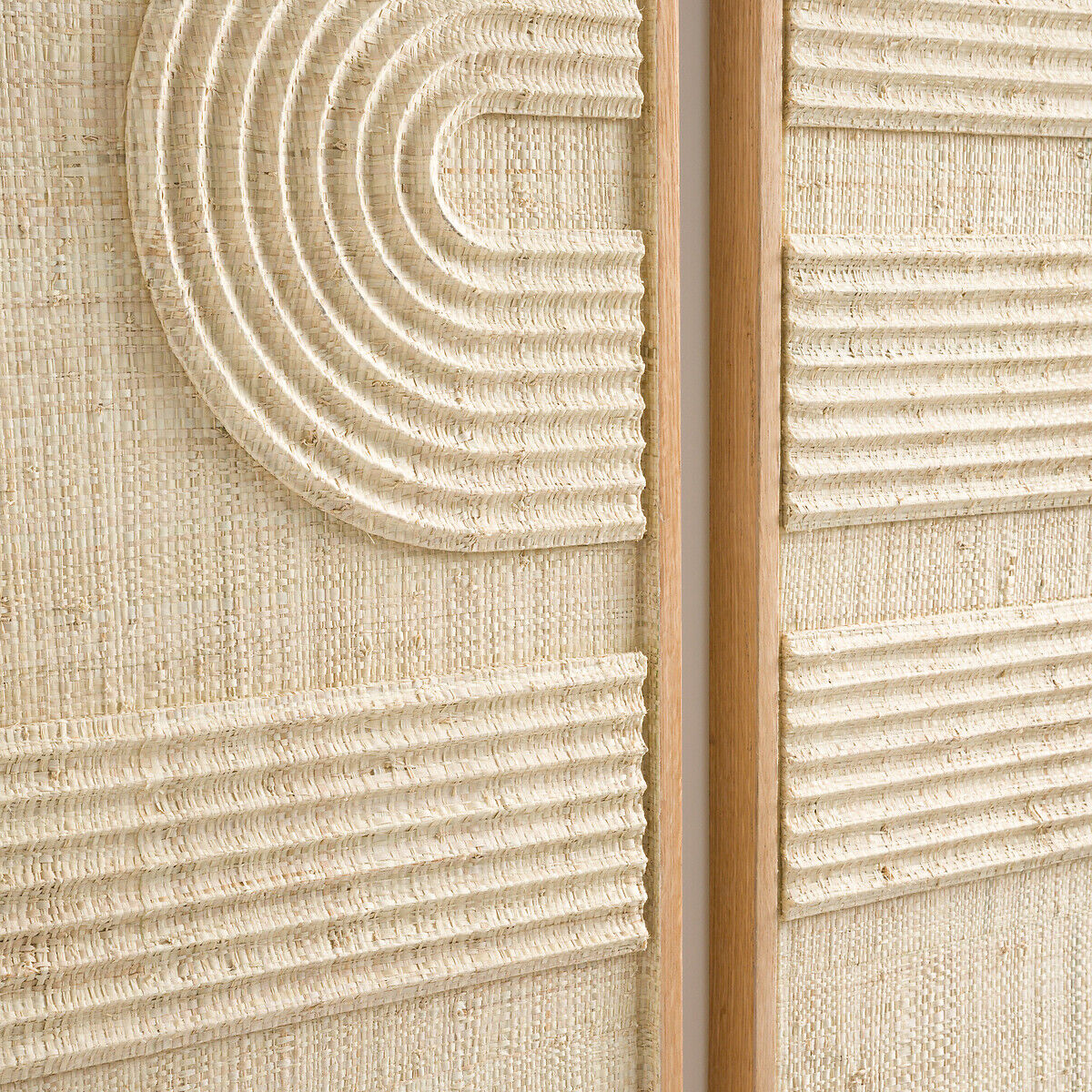
AM.PM Art mural en duo, palmier tissé, TelagaUne création contemporaine au motif abstrait et en relief. Les décorations murales Telaga présentent un motif linéaire qui se prolonge d'une toile à l'autre. Les deux tableaux sont fabriqués en feuilles de palmier tissées à la main et appliquées sur un panneau sculpté. Le tissage d’inspiration ethnique fait de chaque diptyque, des pièces uniques. Description • Feuilles de palmier tissées • Tressage artisanal fait à la main. Chaque pièce est unique • Support en MDF sculpté • Cadre en pin • Barre de fixation (vis et chevilles non fournies) • Fixation murale horizontale ou verticale Dimensions • Largeur : 60 cm • Hauteur : 120 cm • Épaisseur : 4 cm Dimensions et poids des colis 1 colis • L133 x H21 x P72 cm, 20 kg479,20 €*Shipping: 9,99 €Secure redirect to the provider
-
How do you distinguish a cation from an anion?
Cations are positively charged ions, while anions are negatively charged ions. Cations are formed when an atom loses one or more electrons, resulting in a net positive charge. Anions are formed when an atom gains one or more electrons, resulting in a net negative charge. One way to distinguish between cations and anions is to observe their behavior in a solution: cations are attracted to the negative electrode (cathode) in electrolysis, while anions are attracted to the positive electrode (anode). Additionally, cations are usually smaller in size than their parent atoms, while anions are larger. **
-
How is the reduction of the dichromate anion carried out?
The reduction of the dichromate anion is typically carried out using a reducing agent such as sulfur dioxide, iron(II) salts, or thiosulfate. These reducing agents donate electrons to the dichromate anion, causing it to be reduced to chromium(III) ions. The reaction is usually carried out in an acidic solution to provide the necessary conditions for the reduction to occur efficiently. **
-
How is the sodium cation connected to a chloride anion?
The sodium cation is connected to a chloride anion through ionic bonding. In this type of bonding, the sodium atom loses an electron to become a positively charged cation, while the chloride atom gains an electron to become a negatively charged anion. The opposite charges of the sodium cation and chloride anion attract each other, forming a strong bond between the two ions. This ionic bond creates a stable compound known as sodium chloride, or table salt. **
-
Why is there no KSO4 molecule? Why is it an anion?
There is no KSO4 molecule because potassium (K) is a metal and sulfate (SO4) is a polyatomic ion. When potassium combines with sulfate, it forms the ionic compound potassium sulfate (K2SO4), in which potassium loses an electron to become a positively charged ion (K+) and sulfate gains two electrons to become a negatively charged ion (SO4^2-). This ionic bond between the positively charged potassium ion and the negatively charged sulfate ion results in the formation of an anion rather than a molecule. **
* All prices are inclusive of VAT and, if applicable, plus shipping costs. The offer information is based on the details provided by the respective shop and is updated through automated processes. Real-time updates do not occur, so deviations can occur in individual cases. ** Note: Parts of this content were created by AI.